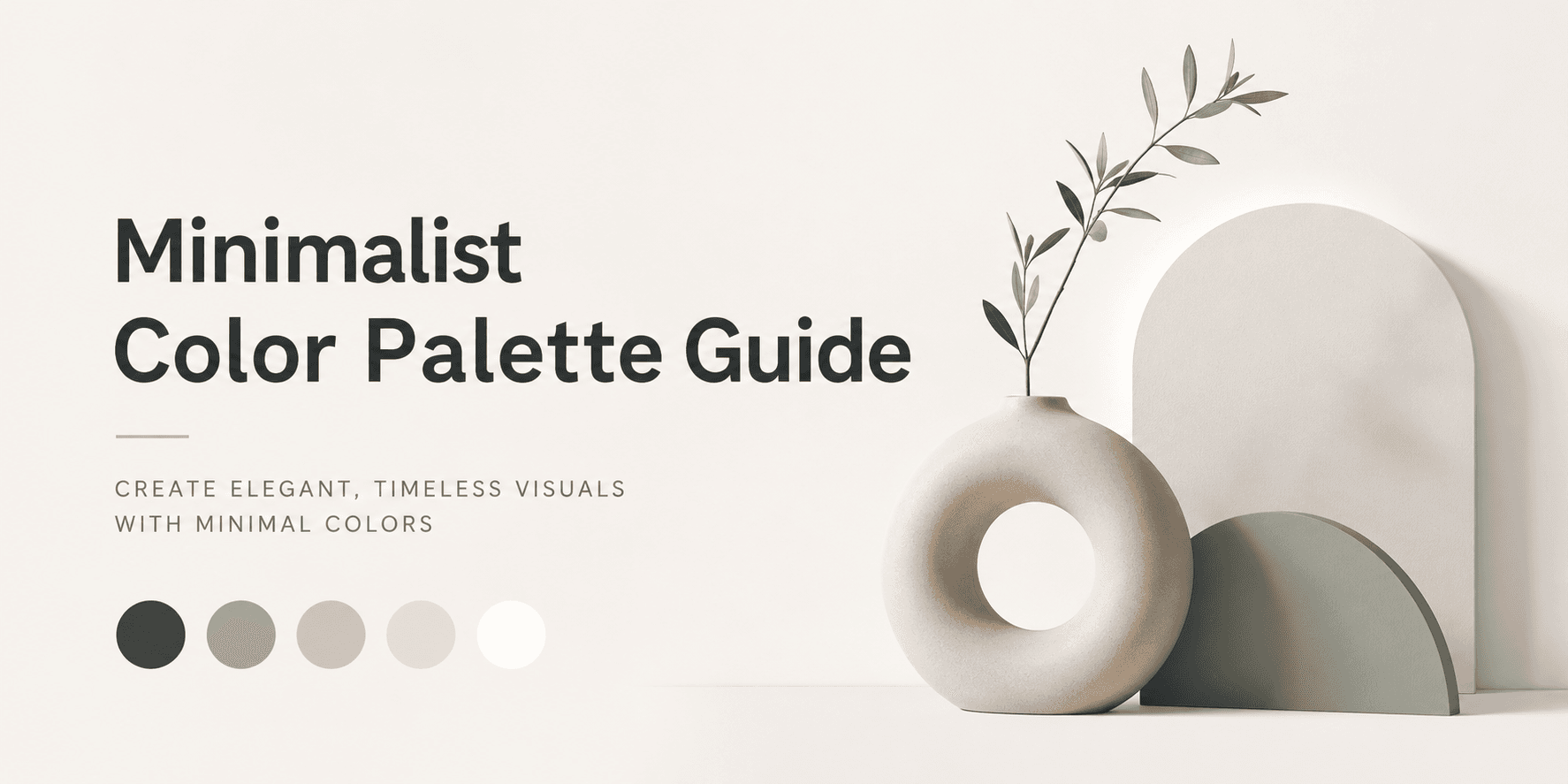
It’s no coincidence that some visuals make you pause scrolling. These don’t shout. They don’t fight for your attention with a whole bunch of other colors. They simply are — clean, purposeful, and completely confident. The thing about such visuals is that there is often one key element behind their success – a smartly selected, minimalistic color scheme.
For designers, UXers, content creators, and anyone else whose job involves visual communication, learning how to construct and leverage minimalist color schemes should be among your top priorities. This guide walks you through everything — from the core principles to the most common traps — with practical tools from Coloraccy woven throughout.
What Is a Minimalist Color Palette?
A minimalist color palette is a deliberately limited selection of colors — typically two to five — chosen to work harmoniously together while reducing visual noise. The philosophy behind minimalism in color is not about restriction for its own sake. It is about exercising control so that every color earns its place and communicates something specific.
In practical terms, a minimalist palette usually consists of:
One dominant neutral (white, off-white, warm grey, or deep charcoal)
One or two supporting tones that add depth without overwhelming
One intentional accent color is used sparingly to create visual hierarchy
The aim is unity. If fewer colors are used for a specific reason, the viewer’s eyes will flow more easily through the composition without getting tired. According to studies done by the Nielsen Norman Group, the clarity of visuals affects the user’s level of trust and sense of professionalism.
You can explore a curated library of ready-to-use color palettes on Coloraccy, including collections tailored for minimalist and modern aesthetics.
Why Minimalist Color Palettes Matter for Elegant Design
Restraint is a design skill. Choosing not to add another color is often harder — and more impactful — than choosing to add one.
The Psychology Behind Fewer Colors
Overload of colors causes mental exhaustion. When there are too many clashing colors, the brain will use its resources to solve this problem rather than concentrating on communication. With minimalistic color schemes, all this energy expenditure is spared, as these color schemes focus the gaze, create mood, and promote the brand image, all without any need of effort from the viewer.
This has long been known by luxury brands. Just consider how high-end fashion brands, premium tech gadgets, and exclusive hotels use color – their palettes are invariably limited, deliberate, and highly controlled.
Versatility Across Formats
A minimalist color palette created with intentionality can be easily applied to all mediums: digital devices, print materials, signage, packaging, and interior environments. Such versatility is particularly important in sectors like hotels, retail, and corporate offices, where the visual identity of the brand needs to be consistent both physically and digitally.
For design professionals operating within the realm of Qatar’s business world, where one might create anything from the interiors of luxury shopping malls to the lobbies of five-star hotels, it is essential to maintain a rigorous approach to color.
Explore how Coloraccy's palette showcases and organizes curated themes to help you find an aesthetic direction immediately.
Building a Minimalist Color Palette: Features and Process
Creating a palette that feels effortless actually requires a deliberate process. Here is how professionals approach it.
Step 1 — Define Your Emotional Anchor
Before picking a single color, decide on the feeling you want your visuals to communicate. Calm and trustworthy? Energetic and modern? Warm and approachable? This emotional anchor should drive every subsequent choice. Colors are not neutral — they carry associations shaped by culture, context, and contrast.
Step 2 — Choose Your Dominant Neutral
Most minimalist palettes live or die by their neutrals. A warm off-white reads differently from a stark cool white. A charcoal grey carries a different weight than a soft slate. Use Coloraccy's color picker to test neutrals against your existing brand elements before committing.
Step 3 — Add One or Two Supporting Tones
Supporting tones give the palette dimension without breaking its minimalist character. These are typically muted versions of a single hue — consider desaturated blues, dusty rose, warm sand, or sage green. Tools like the shade and tint generator make it easy to explore the full tonal range of any given color and find the version that fits your palette's mood.
Step 4 — Select a Single Accent
Your accent is the color that does the work — it draws the eye to calls-to-action, key headings, or important design elements. Choose something that contrasts meaningfully with your neutrals without creating tension. Complementary relationships work well here, and Coloraccy's complementary color finder takes the guesswork out of the process.
Step 5 — Test in Context
A color palette that seems to work well on its own can surprise you in actual applications. Try your color palette against light and dark backgrounds, at various scales, and when used alongside typography. Coloraccy's image color extractor is particularly useful for testing whether a palette feels harmonious when pulled from reference imagery.
Step 6 — Document Your Palette
Once you have finalized your choices, document them properly. A brand color kit ensures that your palette is applied consistently across every deliverable. Record hex codes, RGB values, and CMYK equivalents using Coloraccy's color format converter so that no translation errors creep in between digital and print applications.
Exploring Aesthetic Directions Within Minimalism
Minimalism is not a single look. It is a discipline that manifests differently depending on the aesthetic direction of a project. Here are several directions worth exploring — each with its own character and application.
Abstract Minimalism
Abstract minimalism pairs geometric forms with very limited color fields. Think of large blocks of a single tone offset by a thin accent line. This style works particularly well for editorial design, architecture portfolios, and high-end branding. Browse abstract palette collections on Coloraccy for immediate inspiration.
Academic and Institutional Palettes
There is a specific kind of restrained elegance associated with academic aesthetics — deep navies, aged cream, warm browns, and forest greens used with precision. If your project needs to communicate credibility and intellectual depth, an academia palette may be the right starting point.
Acrylic and Textural Minimalism
Acrylic-inspired palettes introduce slightly more saturation but maintain minimalist discipline through limited color count. They often feel modern and tactile, popular in packaging and consumer goods. Explore the acrylic palette range for this aesthetic direction.
Aesthetic and Lifestyle Palettes
Lifestyle and content brands — particularly in fashion, wellness, and hospitality — often gravitate toward softer, more curated aesthetics. The aesthetic palette collection at Coloraccy covers this territory with warmth and precision.
African-Inspired Minimalism
There is a rich tradition of bold, earth-based color in African visual culture that translates beautifully into minimalist frameworks when handled thoughtfully. The African palette collection on Coloraccy offers a starting point for culturally grounded, distinctive work.
Practical Tips for Applying Minimalist Color Palettes
Knowing your palette is one thing. Applying it consistently across real projects is another. Here are the insights that make the difference between a palette that looks good on paper and one that works in production.
Use the 60-30-10 rule. Assign roughly 60% of your visual space to the dominant neutral, 30% to the supporting tone, and 10% to your accent. This ratio creates balance without making the design feel monotonous.
Let white space do work. In minimalist design, space is not absence — it is an active element. Resist the urge to fill every area with color or content. White space frames and elevates what is there.
Be consistent with typography contrast. Minimalist palettes often involve low-contrast color relationships, which can create legibility issues when combined with text. Always verify text contrast ratios meet WCAG accessibility standards.
Match palette warmth to context. Warm neutrals (cream, warm grey, sand) feel approachable and personal. Cool neutrals (pure white, steel grey, blue-tinted white) feel precise and professional. Choose based on your brand's relationship with its audience.
Use random generation for inspiration, not final decisions. Coloraccy's random color generator is a useful tool for breaking creative blocks, but always refine generated palettes before using them in client work.
Match digital and print values precisely. Colors render differently across screens and print media. Always use the color format converter to ensure your hex, RGB, and CMYK values are aligned before sending files to print.
Minimalist vs. Maximalist Color Palettes
Factor | Minimalist Palette | Maximalist Palette |
Color count | 2–5 colors | 6+ colors |
Visual complexity | Low | High |
Brand recall | Strong (simple associations) | Variable |
Cross-format consistency | Excellent | Challenging |
Design flexibility | High (versatile foundation) | Lower (context-specific) |
Time to apply correctly | Faster | Slower |
Risk of visual fatigue | Low | Higher |
Minimalist palettes are not inherently superior — but they are more forgiving, more transferable, and easier to apply consistently at scale. For most commercial design projects, they offer a stronger foundation.
Common Mistakes to Avoid
Even experienced designers make predictable errors when working with minimalist color palettes. Here are the most important ones to watch for.
Choosing colors in isolation. A color that looks perfect on its own may clash or feel flat when placed next to your other palette choices. Always evaluate colors in combination, not individually.
Forgetting about tonal variation. A palette of three distinct hues with no tonal variation can feel rigid and two-dimensional. Include at least one lighter and one darker variation of your key colors to give yourself flexibility in application.
Overusing the accent. An accent color loses its power when it appears too frequently. If your accent is showing up on more than 10–15% of your visual space, it is no longer acting as an accent — it has become a primary color, and your palette has shifted.
Neglecting accessibility. Low-contrast minimalist color combinations can be visually elegant but functionally inaccessible. Always test your palette against WCAG contrast standards, particularly for text-heavy applications.
Not documenting the palette properly. One of the most expensive mistakes in commercial design is failing to document exact color values. Inconsistent application across deliverables — particularly between agencies, printers, and internal teams — undermines brand coherence. Build and share a complete brand color kit from the start.
Following trends over purpose. Sage green and warm beige are popular minimalist palette choices right now — but a palette chosen because it is trendy rather than because it fits your brand will feel dated quickly. Root your choices in your brand's specific purpose and audience.
Semantically Related Concepts Worth Understanding
To work confidently with minimalist color palettes, it helps to understand a few related concepts that frequently come into play.
Color harmony refers to the relationship between colors based on their positions on the color wheel. Common harmonious relationships include complementary (opposite hues), analogous (adjacent hues), and triadic (equidistant hues). Most minimalist palettes use analogous or complementary relationships.
Saturation and chroma describe the intensity of a color. Minimalist palettes typically favor desaturated or muted tones, which feel calmer and more sophisticated than fully saturated versions of the same hues.
Value refers to the lightness or darkness of a color. A well-constructed minimalist palette includes a thoughtful range of values — from light to dark — even if the hues themselves are limited.
Color temperature describes whether a color reads as warm or cool. Warm palettes (yellows, reds, oranges, warm neutrals) feel different from cool palettes (blues, greens, cool greys), and mixing temperatures without intention can create unease.
Use Coloraccy's complementary color finder and the full palette showcase to explore how these concepts play out across real palette examples.
Conclusion: Build Elegant Visuals With Intention
Minimalist color palettes are not about doing less — they are about achieving more with less. When every color in your visual toolkit earns its place, your designs communicate with greater clarity, greater consistency, and greater lasting power.
The process starts with understanding the principles, continues with deliberate selection, and holds together through consistent application across every format and deliverable. From defining your emotional anchor to documenting your brand color kit, each step matters.
Coloraccy exists to make that process faster, more intuitive, and more reliable. Whether you need a starting point from a curated color palette library, a tool to generate shades and tints, or a format converter to keep your values precise across print and digital, the full toolkit is at coloraccy.com.
Start building your minimalist color palette today. Visit Coloraccy and explore the tools, collections, and resources that help designers and brands create visuals that are clean, timeless, and genuinely elegant.