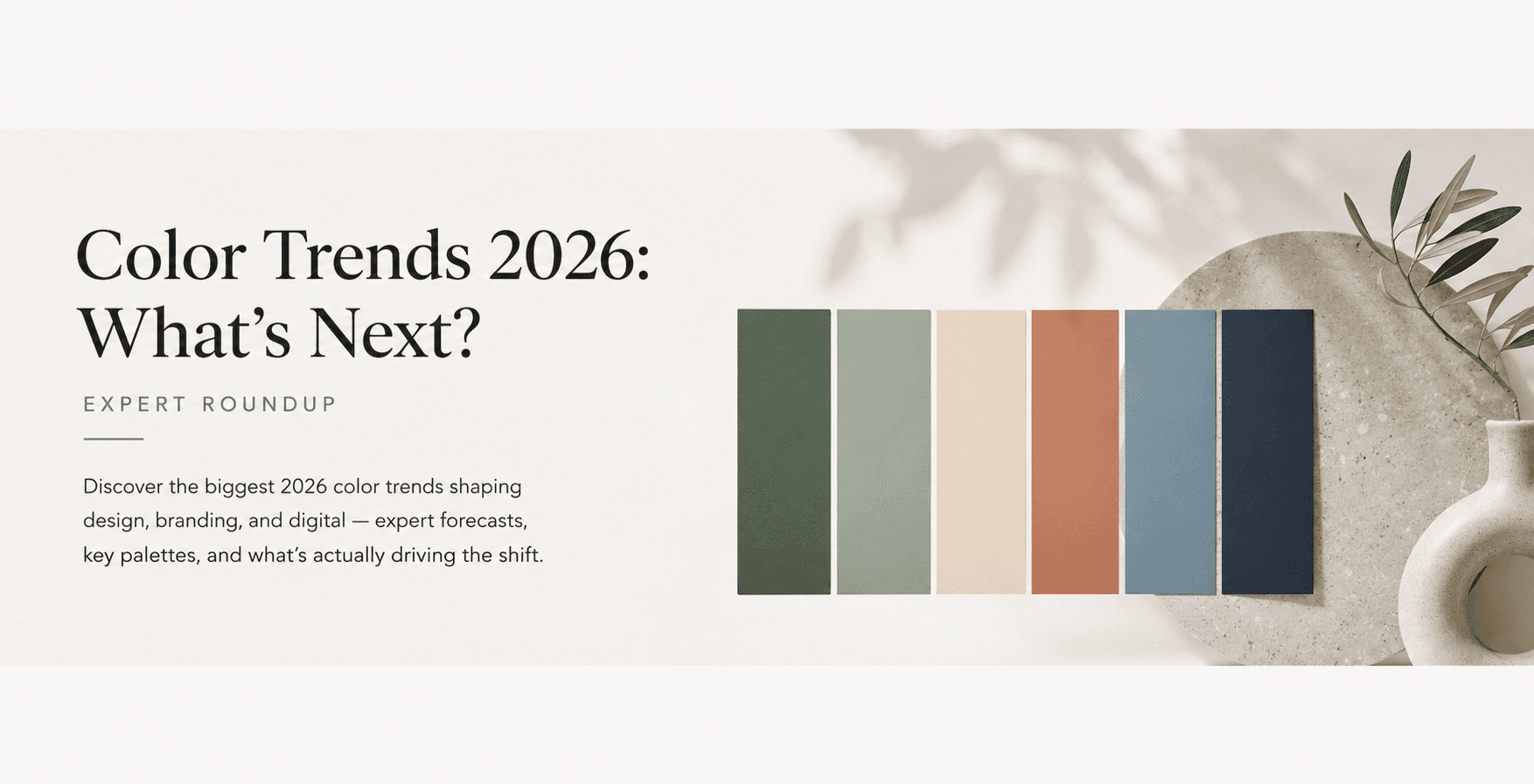
Every few years, something shifts in the collective visual mood. It is not one person's decision or one brand's campaign — it is a convergence of cultural tension, technological change, and a shared, almost unconscious need for something different. That shift is happening right now, and the 2026 color trends reflect it clearly.
This year's design color forecasts are not just about specific hues. They are about what those hues mean — why dusty greens feel more relevant than ever, why certain blues are becoming synonymous with digital trust, and why the pendulum is swinging back toward warmth after years of cold, sterile minimalism.
This roundup synthesizes signals from branding agencies, UI design communities, interior forecasters, and color standard-setters to give you a clear picture of where color is heading — and how to use that knowledge in your work.
How Color Trends Actually Form
Before the trends themselves, it is worth understanding where they come from, because design color forecasts are not invented by trend agencies. They are observed and then amplified.
Color forecasters track signals across fashion, architecture, automotive design, consumer electronics, film and television, social media aesthetics, and economic sentiment. When the same shift appears independently across multiple industries at the same time, that is a trend forming.
In 2026, the dominant macro signals are: a continued cultural reorientation toward nature and materiality following years of hyper-digital living; a growing demand for digital interfaces that feel calm and trustworthy rather than stimulating; and a quiet luxury aesthetic that has moved from fashion into interiors, packaging, and UI design..
1. Warm Earth is Becoming the New Neutral
For the better part of the last decade, cool gray was the default neutral in digital and interior design. Gray walls, gray interfaces, gray brand backgrounds. In 2026, that dominance is ending.
Warm earth tones — raw linen, warm sand, undyed cotton, pale terracotta, warm taupe — are replacing cool gray as the ambient neutral of choice. The shift is visible in UI design, where warm off-whites are replacing pure white backgrounds. It is visible in branding, where neutral packaging is moving toward cream and warm beige rather than silver and gray.
For designers building palettes around this direction, the acrylic palette collection on Coloraccy captures this warm, textured quality well — the combinations there demonstrate how to keep warmth feeling sophisticated rather than rustic.
2. The Return of Deep, Saturated Jewel Tones
The quiet luxury movement of the early 2020s pushed color into the background. Everything became muted, desaturated, and careful. In 2026, the pendulum is swinging back — but not toward neon or maximalism. It is swinging toward depth.
Deep jewel tones are re-emerging as signature brand colors: rich forest greens, deep sapphire blues, dark plum, aged burgundy, and warm amber. These are colors that read as confident and considered — not shy, but not loud. They carry historical associations with quality and permanence that lighter, more contemporary palettes deliberately avoid.
The abstract palette collection explores how rich, high-depth colors can be structured into coherent systems without overwhelming the palette — worth exploring if jewel tones are relevant to your current work.
3. Digital Blue is Fracturing Into Sub-Families
For years, "tech blue" was a single recognizable category: a mid-bright, slightly saturated blue that meant digital, trustworthy, and modern. In 2026, that category is splitting.
Three distinct blue directions are emerging:
Institutional blue — deep, slightly cool, associated with governance, finance, and established authority. Think dark navy with a slight gray shift. This is the blue of central banks, legal services, and infrastructure. It is appearing in enterprise software and B2B platforms, repositioning around reliability after years of startup-style brightness.
Calm blue — softer, more desaturated, with a slight green undertone. This is the blue of mental wellness apps, digital healthcare, and productivity tools. It reads as steady and non-demanding — the opposite of the notification-optimized brights of the previous decade.
Electric revival blue — a counterpoint to both of the above. Vivid, almost Y2K-adjacent, appearing in creative tool interfaces, gaming-adjacent design, and youth-oriented fashion brands. It is a deliberate rejection of the corporate-blue safety of the mainstream.
4. Green's Continued Evolution: From Trend to Default
Green has been in transition for several years now. It entered the mainstream as a sustainability signal, then became the color of DTC wellness brands, then spread into tech. In 2026, it is completing a transition from trend color to genuine design default — a new neutral with depth.
They occupy a middle register: muted, slightly olive or sage, clearly natural but not decoratively so. These greens function as the warm counterpart to the cool grays they are gradually replacing — background colors with a little more life, structural colors that carry environmental associations without feeling like a statement.
Exploring the aesthetic palette library on Coloraccy reveals how contemporary designers are integrating these evolved greens into cohesive palettes — the combinations show the tonal balancing act required to make muted green feel refined rather than dull.
5. Off-Black Is Replacing Pure Black
This is a quiet trend that is happening almost below the level of conscious observation, but it is real and accelerating. Pure black — #000000 or very close to it — is losing ground in UI and brand design to what designers are calling "off-black": very dark values with a slight warm or cool hue built in.
Warm off-blacks (dark brown-blacks, almost like very deep espresso) feel more material, more analog, more connected to physical objects. Cool off-blacks (dark charcoal-blues, very deep slate) feel more considered and precise than pure black without the coldness of a stark contrast.
6. Soft Metallics Are Replacing High-Gloss Finishes
Metallic colors in design — gold, silver, bronze — have cycled between excess and restraint for decades. In 2026, they are landing firmly in the restrained category. High-gloss, mirror-finish metallic accents feel dated. What is current is softer: matte gold, aged bronze, brushed pewter, oxidized copper.
In palette terms, soft metallics function best as accent colors within warm-neutral systems. A warm linen base with a matte gold accent reads as quietly luxurious. The same gold against a cool gray reads discordant. Context and tonal temperature compatibility matter more with metallic tones than with almost any other color category.
7. Regional Color Influences Are Going Global
One of the most interesting 2026 color trends is the growing influence of regional color traditions on global design culture. This is not the superficial exoticization of earlier decades — it is a more genuine engagement with the specific color vocabularies that have developed in different parts of the world.
African textile traditions — the deep indigos of West African resist dyeing, the ochres and terracottas of East African beadwork, the rich geometric color relationships of Southern African weaving — are influencing brand design and editorial color palettes globally. The African palette collection on Coloraccy curates examples of how these color relationships translate into contemporary design contexts.
8. Pastels Are Maturing
Pastel colors have been a near-constant feature of digital aesthetics for the better part of a decade. In 2026, they are not disappearing — but they are maturing. The very pale, highly tinted pastels of earlier years (barely-there pinks, near-white mints) are giving way to slightly deeper, more saturated versions with more character.
For brand and UI designers working with pastel directions, the pastel color palette generator guide explores how to find and calibrate this mature pastel register — the difference between pastels that feel current and those that feel dated is often a matter of saturation and temperature adjustments within a narrow range.
9. The Slow Death of Pure White Backgrounds
Closely related to the warm earth trend, pure white (#FFFFFF) is declining as the default background color in digital design. It is being replaced by warm whites, soft creams, and pale off-whites — functionally neutral colors but carry a degree of warmth that pure white lacks.
The practical driver here is extended screen use. Pure white on a backlit screen is demanding on the eyes for long reading sessions. Warm off-white backgrounds reduce this slightly while maintaining the clean, uncluttered quality that white provides.
This shift has significant implications for accessibility as well as aesthetics. When moving away from pure white, it is essential to verify that your text colors still meet contrast requirements against the new background. Understanding WCAG color contrast standards becomes more practically relevant when your neutral background shifts from #FFFFFF to #FAF7F2 — the contrast ratios change, and they need checking.
10. Color Storytelling Across Touchpoints
The most sophisticated development in design color forecasting for 2026 is not about any single color or palette — it is about how brands are thinking about color across the full range of their touchpoints. Screen, print, packaging, space, and clothing are each subject to different color rendering conditions, and the most progressive brands are building color systems that account for this explicitly.
A brand color that looks correct on a calibrated design monitor may read differently on a consumer phone screen, differently again in print, and differently still when reproduced in textile.
For designers beginning to think in these terms, understanding how to build and document a palette that travels well across contexts is essential.
Applying These Trends Without Losing Your Identity
A note on trend adoption, because it matters: color trends are signals, not instructions. The designers doing the most interesting work in 2026 are not the ones who have simply switched their palettes to match the forecast. They are the ones who have understood the cultural drivers behind these trends and found ways to express them through their own specific brand or project lens.
Warm earth replacing cool gray does not mean every brand should add terracotta. It means the broader cultural appetite for warmth and materiality is real, and there are probably ways to express that quality within your existing color direction that feel true to your identity.
The color palette library on Coloraccy — with its range of curated styles, moods, and cultural references — is built precisely for this kind of exploratory thinking. Browse it not to copy, but to develop your own color intuition within the current landscape.
Conclusion
The 2026 color trends tell a coherent story: a broad cultural pivot toward warmth, depth, materiality, and calm — away from the hyper-stimulating, high-contrast, cool-toned digital aesthetics that defined the previous decade. Every specific trend on this list is an expression of that larger movement.
Understanding these shifts is valuable. But the most durable color decisions are always the ones rooted in a specific brand's story, audience, and context — with trend awareness informing rather than overriding that foundation.